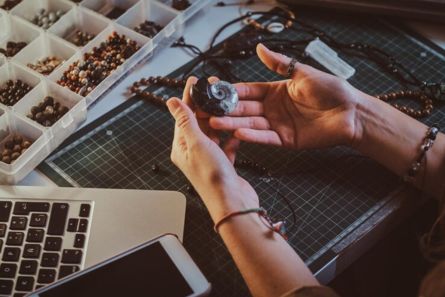
Taking jewellery making classes can be a great way to learn how to make your own jewellery, especially if you are completely new to the craft. A structured class can give you access to an instructor, practical demonstrations, equipment, and other people who are learning alongside you.
However, attending a formal class is not the only way to learn jewellery making.
If you prefer to learn independently, there are plenty of online tutorials, courses, videos, books, and other resources that can help you develop your skills at your own pace.
If you are thinking about taking jewellery making seriously, particularly as a hobby that you may eventually turn into a business, the important question is not simply whether classes are good or bad.
The better question is:
Are jewellery making classes the right way for you to learn?
Let’s look at the advantages and disadvantages of formal classes and compare them with self-study.
What Is Jewellery Making?
Jewellery making is the process of designing and creating decorative items such as necklaces, bracelets, earrings, rings, and other accessories.
Depending on the type of jewellery you want to create, you may work with materials such as:
- Beads
- Wire
- Metal
- Precious or semi-precious stones
- Clay
- Resin
- Fabric
- Findings and clasps
Different techniques require different tools and levels of experience.
A beginner might start with simple beadwork or wire jewellery before progressing to more advanced techniques such as metalworking, stone setting, soldering, or fabrication.
For a general introduction, you can learn more about jewellery and its different forms and traditions.
Should You Take Jewellery Making Classes?
There is no universal answer.
Your decision can depend on:
- Your current skill level
- Your learning style
- Your budget
- Your schedule
- The techniques you want to learn
- Whether you prefer practical instruction
- Whether you want to turn jewellery making into a business
If you learn best by watching someone demonstrate a technique and then trying it yourself, a class may be particularly useful.
If you prefer experimenting independently, self-study may be enough.
The Advantages of Jewellery Making Classes
Formal classes provide several benefits, especially for beginners.
1. Learn Practical Techniques From an Instructor
One of the main advantages of jewellery making classes is having someone demonstrate the techniques in person.
A teacher can show you how to perform tasks such as:
- Bead knotting
- Closing crimps
- Attaching clasps
- Working with wire
- Measuring materials
- Using jewellery-making tools
- Finishing pieces neatly
Some techniques can be difficult to understand from written instructions alone.
Being able to watch a technique and immediately try it can make the learning process easier.
2. Get Immediate Feedback
Another advantage of an instructor is immediate feedback.
If you make a mistake, you can ask someone to show you what went wrong and how to correct it.
For a beginner, this can prevent small technical mistakes from becoming habits.
An instructor may also be able to suggest a better technique or demonstrate an alternative approach.
3. Learn Different Jewellery-Making Techniques
A structured jewellery course may introduce you to techniques that you would not necessarily discover on your own.
Depending on the course, you might learn:
- Beading
- Wire wrapping
- Jewellery assembly
- Basic metalwork
- Design principles
- Finishing techniques
- Tool handling
As your skills develop, you can experiment with combinations of techniques and begin developing your own designs.
4. Develop Your Own Designs
Learning jewellery making is not only about copying existing designs.
A good course can give you the technical foundation needed to start developing your own ideas.
Once you understand how materials and techniques work together, you can begin experimenting with:
- Shapes
- Colors
- Textures
- Materials
- Patterns
- Different closures
- Layering
- Proportions
The technical knowledge gives you more freedom to create something original.
5. Meet Other Jewellery Makers
A class can also provide a social benefit.
You will be learning alongside other people who are interested in jewellery making.
This can provide opportunities to:
- Exchange ideas
- Share techniques
- Get feedback
- Find inspiration
- Make creative connections
If you are naturally social, this can be one of the most enjoyable parts of attending a class.
Networking Can Help if You Want to Start a Jewellery Business
If your long-term goal is to make money from jewellery making, networking can be particularly useful.
People you meet through classes may eventually become:
- Customers
- Business contacts
- Creative collaborators
- Suppliers
- Event contacts
- Sources of referrals
You may also discover local craft fairs, exhibitions, markets, workshops, or other opportunities through your jewellery-making community.
Building relationships can be just as valuable as learning the techniques themselves.
The Disadvantages of Jewellery Making Classes
Formal classes are not perfect for everyone.
There are several reasons why you may decide that a class is not the right option.
1. Classes Can Be Expensive
Tuition fees can vary considerably depending on the instructor, location, course length, equipment, and type of jewellery making being taught.
You may also need to pay for:
- Materials
- Tools
- Travel
- Protective equipment
- Additional workshop sessions
If you are only experimenting with jewellery making as a hobby, the cost of a formal course may be more than you want to spend initially.
2. Classes Require a Fixed Schedule
A classroom course usually takes place at specific times.
That can be difficult if you have:
- A full-time job
- Family responsibilities
- Other studies
- Travel commitments
- An unpredictable schedule
Self-study can be more flexible because you can learn whenever you have time.
3. The Location May Not Be Convenient
A good jewellery-making class may not be available near you.
You might have to travel a long distance to attend a suitable workshop.
That adds both time and transportation costs.
4. The Teaching Style May Not Suit You
Not everyone learns in the same way.
Some people enjoy demonstrations and group instruction.
Others prefer reading, watching videos, experimenting, and learning independently.
You might also find that the pace of a class is too fast or too slow for your learning style.
Self-Study Is Another Way to Learn Jewellery Making
If attending jewellery making classes does not suit your situation, self-study can be an effective alternative.
The internet has made it much easier to learn creative skills independently.
You can find:
- Video tutorials
- Online courses
- Step-by-step guides
- Books
- Blogs
- Community forums
- Jewellery design resources
You can study these materials in your own time and then practice the techniques yourself.
The biggest difference is that you will need to be more self-directed.
The Advantages of Self-Study
Learn at Your Own Pace
You can spend as much time as you need on a particular technique.
If something is difficult, you can repeat the lesson several times.
If something is easy, you can move on immediately.
Study Whenever You Want
There is no classroom schedule.
You can practice in the morning, evening, weekends, or whenever your schedule allows.
Start With a Smaller Budget
You can begin with basic materials and tools rather than paying for an expensive course.
As your confidence grows, you can gradually invest in better equipment.
Experiment Freely
Self-study gives you freedom to try different techniques without following a fixed curriculum.
You can combine ideas from several sources and develop your own approach.
The Disadvantages of Self-Study
Self-study also comes with challenges.
You May Develop Bad Habits
Without an instructor, you may not realize that you are using an inefficient or incorrect technique.
This is particularly relevant when learning more technical forms of jewellery making.
It Can Be Harder to Stay Motivated
When nobody is expecting you to attend a class, it can be easier to postpone practice.
A structured learning schedule can provide useful accountability.
You May Need to Research More
Instead of having one instructor answer your questions, you may need to search through several tutorials and resources before finding a solution.
That can take additional time.
A Hybrid Approach Can Work Well
You do not necessarily have to choose between formal classes and self-study.
A combination can work very well.
For example, you could take an introductory class to learn the fundamentals and then continue developing your skills independently.
This approach gives you:
Structured instruction + independent experimentation
You can use classes to learn techniques correctly and online resources to explore areas that interest you.
How to Choose the Right Jewellery Making Class
If you decide to take a class, do some research first.
Look for information about:
Course Content
What techniques will you actually learn?
Skill Level
Is the course designed for complete beginners or experienced jewellery makers?
Class Size
Smaller classes may provide more opportunities for individual feedback.
Tools and Materials
Check whether tools and materials are included in the course fee.
Instructor Experience
Look at the instructor’s jewellery-making background and previous work.
Reviews
Reviews from previous students can help you understand what the learning experience is like.
Cost
Compare the total cost rather than looking only at tuition.
Remember to include materials, tools, travel, and any additional workshop expenses.
Think About Your Goal Before Enrolling
Your reason for learning jewellery making should influence the type of course you choose.
Learning as a Hobby
A short beginner workshop may be enough.
Building Professional Skills
You may want a more structured course covering advanced techniques.
Starting a Jewellery Business
Look for opportunities to learn not only jewellery-making techniques but also areas such as product development, pricing, photography, branding, and selling.
Improving an Existing Skill
Choose a specialist workshop that focuses on the technique you specifically want to improve.
If You Want to Make Money From Jewellery
Learning the craft is only the beginning if your goal is to build a jewellery business.
You will also need to understand:
- Product pricing
- Materials costs
- Packaging
- Photography
- Branding
- Social media marketing
- Ecommerce
- Customer service
- Shipping
You can use your jewellery-making skills to create products for online marketplaces, your own website, craft fairs, exhibitions, and other sales channels.
Your creative skills and business skills need to develop together.
Practice Is More Important Than the Classroom
Whether you choose formal jewellery making classes or teach yourself, practice is essential.
The first piece you make may not look the way you expected.
That is normal.
You may make mistakes with:
- Measurements
- Wire
- Clasps
- Beads
- Finishing
- Proportions
Each mistake can teach you something.
Keep practicing and gradually increase the complexity of your projects.
Keep a Record of Your Progress
One useful way to improve is to document your work.
Take photographs of finished pieces and keep notes about:
- Materials used
- Techniques learned
- Problems encountered
- Time spent
- What you would change
- What worked well
Over time, you will have a visual record of how your jewellery-making skills have developed.
This can also become the beginning of a portfolio if you eventually decide to sell your work.
Start Small
You do not need an enormous collection of tools and materials when you are just beginning.
Start with a small project that matches your current skill level.
For example:
Beginner: Simple bracelet
Next: Necklace with multiple components
Later: More complex wire or metalwork
Progress gradually.
Learning one technique properly is usually more useful than buying lots of equipment and trying to master everything at once.
Build Your Own Jewellery-Making Style
As you become more experienced, pay attention to what you naturally enjoy creating.
You may find yourself drawn toward:
- Minimalist jewellery
- Statement pieces
- Beaded designs
- Wire jewellery
- Metalwork
- Handmade accessories
- Contemporary designs
- Traditional-inspired pieces
Experimentation can eventually lead to a recognizable style.
Your personal style can become especially important if you want to build a jewellery brand.
Final Thoughts
Taking jewellery making classes can be an excellent way to learn, particularly if you are a complete beginner and benefit from hands-on instruction and direct feedback.
Classes can teach you practical techniques, introduce you to new materials, help you develop your own designs, and allow you to meet other people interested in jewellery making.
However, formal classes are not the only route.
Self-study can be more affordable, flexible, and convenient, particularly if you enjoy learning independently.
Ultimately, the best learning method depends on your goals, budget, schedule, and preferred learning style.
You can also combine the two approaches: learn the fundamentals through a class and then continue practicing and experimenting independently.
Whether you learn in a classroom or at home, the most important thing is to keep practicing, experimenting, and developing your skills.
If your ultimate goal is to turn jewellery making into a business, remember that learning the craft is only one part of the journey. You will also need to develop your pricing, branding, marketing, and selling skills.
For more creative resources, visit Phroenix Media and explore our articles about art, photography, social media, and other creative careers.