Writing a compelling screenplay requires both creative vision and technical precision. In fact, learning how to write a script for a short film is one of the most effective ways for aspiring screenwriters and directors to launch their careers. Whether you plan to submit your project to film festivals or produce it independently, industry-standard formatting is essential.
Furthermore, directors, actors, and production crews rely on standardized script layouts to estimate budgets, plan shooting schedules, and visualize scenes accurately. As a result, mastering proper screenplay formatting ensures your script reads professionally from the very first page.
Standard Short Film Script Formatting Rules
Before diving into plot development, writers must understand the foundational rules of screenplay mechanics. Specifically, a standard script page equals roughly one minute of screen time. Therefore, a 10-page screenplay translates to a 10-minute short film.
| Script Element | Formatting Standard | Primary Purpose |
| Typography & Size | 12pt Courier Font, Single Spaced | Maintains exact 1 page = 1 minute industry standard |
| Scene Headings (Slug lines) | ALL CAPS, Left-aligned (e.g., INT. COFFEE SHOP – DAY) | Establishes location, camera perspective, and lighting time |
| Action Lines | Full-width paragraph, present tense | Describes visual character movements and environmental details |
| Character Names | ALL CAPS, Centered above dialogue | Identifies the speaking character clearly |
| Dialogue Blocks | Centered block beneath character name | Represents spoken lines and audio voiceovers |
| Parentheticals | Indented below character name (whispering) |
Provides brief emotional or delivery direction |
Key Elements of Industry-Standard Screenplays
1. Scene Headings (Slug lines)
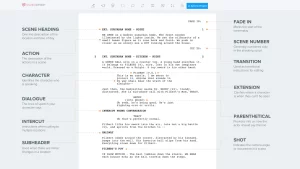
Scene headings tell the production team where and when a scene takes place. Specifically, every slug line begins with INT. (Interior) or EXT. (Exterior), followed by the specific setting and the time of day. For example, INT. COFFEE SHOP - DAY gives immediate visual orientation.
2. Action and Description
In addition to dialogue, a well-written film script should include detailed action and description to help set the scene and establish the tone of the story. Specifically, action lines should be written in present tense and provide a visual description of the characters’ movements and surroundings. However, avoid using passive voice or overly descriptive language, as this can slow down the pacing of the script.
3. Dialogue and Character Formatting
When introducing a character for the first time in action text, write their name in ALL CAPS alongside a brief age or personality descriptor. Afterward, center their name above their spoken lines whenever they speak. However, keep dialogue concise and subtext-heavy to maintain realistic pacing.
Step-by-Step: How to Write a Script for a Short Film
Follow this structured screenwriting sequence to take your project from initial concept to a finished shootable script:
Professional Tips for Writing Standout Short Films
Focus on Visual Storytelling
Cinema is primarily a visual medium. Therefore, rely on visual actions, props, and camera cues rather than heavy expositional dialogue. In fact, studying visual composition in our photography section and creative concepts in our art category offers great inspiration for visual metaphor and color themes.
Keep Locations and Cast Size Minimal
Producing short films independently requires practical resource management. Consequently, limiting your script to one or two locations and a small cast makes your project far easier to budget and film. Likewise, learning project planning supports your broader personal development as an independent filmmaker.
Promote Your Screenplay and Film
Once your short film script is complete, consider how you will market the final project. In addition, leverage targeted marketing strategies to pitch your script to producers. Similarly, sharing behind-the-scenes updates on social media helps build an early audience for festival releases.
Final Thoughts
Learning how to write a script for a short film opens endless doors for creative expression and career advancement. Therefore, focus on mastering standard screenplay formatting, writing sharp dialogue, and telling tight visual stories. As a result, your screenplays will stand out to readers, directors, and festival judges alike.